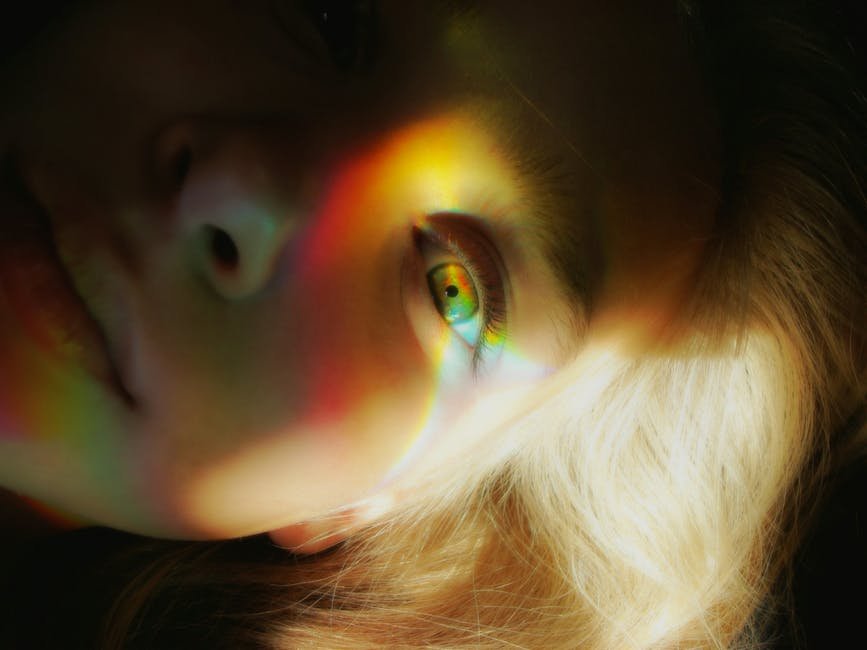
Color: It’s All in Your Head!
You ever stare at a killer Pacific sunset, all that amazing golden orange, and just know it’s a universal thing? Like, everyone sees that, right? Or maybe you’re cruising PCH, ocean super blue next to you. And you figure: yeah, everyone gets this view. Well, buckle up for a mind-bender. That vibrant color perception we actually experience? Not an objective truth flying around. Nope. It’s a total trick. A seriously brilliant illusion. Cooked up sometime between your eyeballs and your brain.
Not Objective At All, Folks
Seriously, think about big stuff. Love. Fear. That amazing art piece that just gets you, no words needed. You try to explain it. Use words, body language, compare it to things. But there’s always a personal take, right? A subjective vibe. Colors? No different. They feel super real. The sun’s yellow. Our state parks’ green. That endless blue sky over the Golden Gate. Yet, they’re utterly relative. Super personal experiences.
This illusion, this reality we think we share, it’s a huge part of how we deal with the world. Also, it’s wild when you realize the “green” you’re seeing – usually between 495 and 570 nanometers – isn’t actually, like, green. It’s just how human eyes see that specific electromagnetic wavelength. Pretty mind-boggling, huh?
Different Eyes, Different Worlds
Our human color experience? Just one piece of cake. Other creatures? Totally different deal. Take dogs, our furry friends. Their world? Less colorful than ours. Because they only work with two kinds of cone cells. Blues and yellows, they got that down. Reds and greens? Not really. It’s an evolution thing. Their eyesight built for hunting and staying alive, not eyeing a Dodger’s game.
But then there are the real vision superstars. Lots of bugs and birds can see ultraviolet light. A whole spectrum we can’t even touch. Seriously. Imagine a flower through a bee’s eyes. What looks like one plain color to us might have these wild, UV-reflecting designs. Like a landing strip for pollinators. And another thing: the absolute boss of vision? Mantis shrimp. This weird deep-sea creature has 16 different cone cell types. Sixteen! We can’t even guess what that rainbow looks like for them. Probably too much for our brains to handle.
Our Simple Three-Cone Reality
So, how do we even make such a rich world of color? It’s all about light. Zipping around. Tiny particles. Photons, they’re called. When these photons hit the back of our eyes, special cells called cone cells get to work. Us humans? We got three types. One that’s best for red light, another for green, and the last for blue.
When photons, say, from a cool morning hitting a surfer’s wake, smack those cone cells, signals shoot to your brain. Your brain then grabs these basic red, green, and blue colors. And like some crazy artist, it mixes and matches. Red and green signals, same time? Boom! Your brain sees yellow. It’s an inference. A tricky puzzle solved on the fly. That’s how we get all the colors we perceive.
When Things Get Muddled: Color Blindness
But sometimes, this smart system hits a total snag. If one or more of those cone cell types has a problem, telling certain colors apart gets real hard. That’s what we call color blindness. Pretty often, it’s genetic. And here’s a wild stat for you: way more common in guys. Affects about 1 in 12 men. Compared to just 1 in 200 women. Typically, reds and greens are the colors that get messed up. Turns a bright scene a bit faded.
Your Phone: A Color Copycat
Ever wonder how your iPhone or that giant TV makes all those amazing colors? Same trick your eyes pull. These digital screens use red, green, and blue pixels. RGB, you know the drill. And by adjusting how bright these three key colors are, they can make literally millions of shades. It’s totally copying our own three-cone vision. A powerful color illusion, right there on your screen.
Evolution’s Wild Eyes
Being able to see different parts of the electromagnetic spectrum? Shows how wild evolution is, how much it can change. Vision has popped up separately over fifty times, in different creatures. Convergent evolution, they call it. Because sight is just super vital for survival. Spotting food. Escaping dangers. Finding a partner.
Like deep-sea creatures, for instance. Many live in total darkness. Take the Black Seadragon. This freaky fish can shoot out red light from its body. Basically a secret weapon. Why red? Because most other deep-sea animals haven’t figured out how to see red light. So it’s their own personal invisibility cloak. Helps them hunt and move around totally unseen.
Scientists See Beyond: False Colors
Our “visible” spectrum? A tiny sliver. Of the whole electromagnetic show around us. What we call “visible” is just what we can see. Other creatures, they got their own “visible” range.
Because our eyes can’t deal with the data, scientists use “false color.” So, when you see those amazing pictures of far-off galaxies from the Hubble Telescope, or cool cell stuff, those bright blues, greens, and purples? Not their real colors. They’re just pictures. Special cameras on telescopes can pick up radio waves, X-rays, other parts of the spectrum we can’t see. Scientists then give visible colors to these unseen wavelengths. Turning raw data into something our human (three-cone) brains can actually get. Otherwise, radio astronomy would be, well, a total bore to look at.
It’s a wild thought, right? That almost everything we assume is a ‘fact’ could just be one take among so many others. Makes you pause, doesn’t it?
Got Questions? We Got Answers!
So, what is “green” light, really?
When humans see ‘green,’ it’s about light wavelengths, usually between 495 and 570 nanometers. Our specific middle-wavelength cone cells pick these up. The light itself isn’t green. It’s just what your brain makes of it.
Why do some animals see UV?
Lots of animals, like bugs and birds, can see ultraviolet (UV) light. It seriously helps them live. For instance, it lets them spot certain patterns on flowers for food. Or see special marks on potential mates that we can’t.
How do screens make so many colors with three basic ones?
Digital screens just use red, green, and blue pixels (RGB). By changing the brightness and how these three mix, the screen can make a ton of colors. It tricks our eyes into seeing a whole range of them.